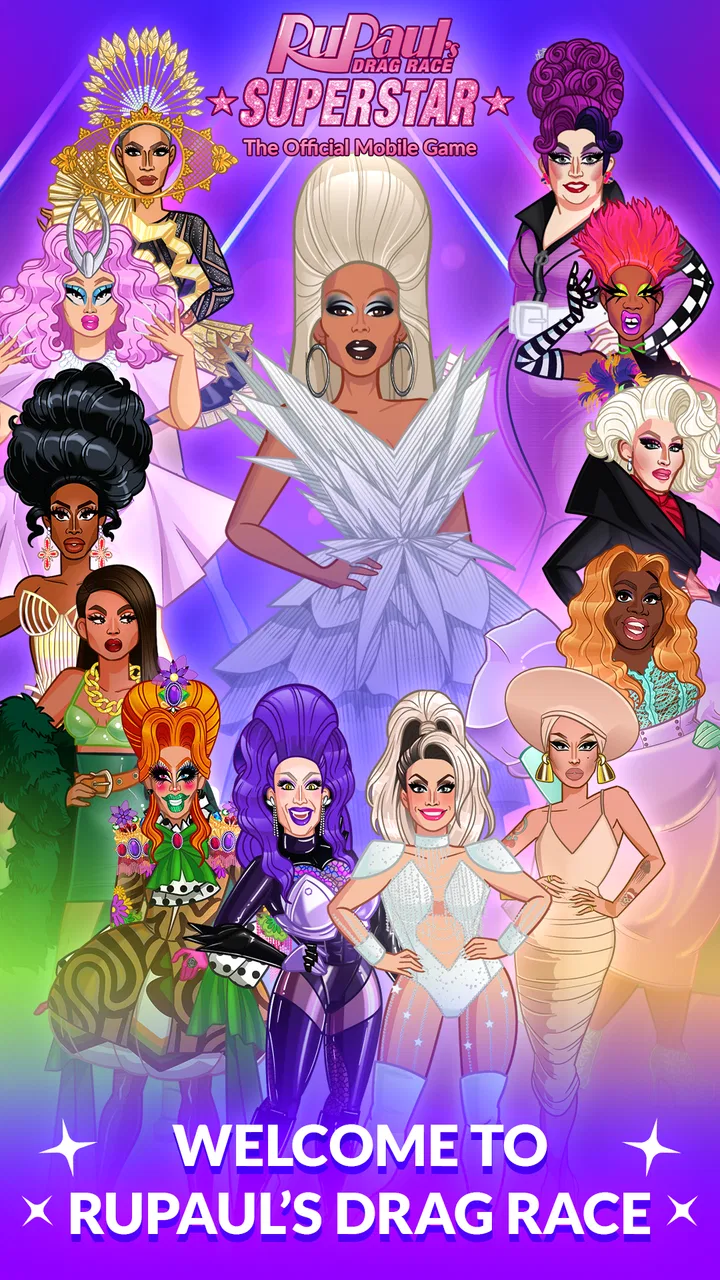
RuPaul's Drag Race Superstar
- 4.3
- Rating
- 1.00M
- Installs
- Free
- Price

 Analysis by App-foxy
I spent my time with RuPaul's Drag Race Superstar focusing on the part that gives it the clearest identity: creating a drag look and then putting that look against other players’ style choices. It is a free simulation game from East Side Games Studio, but calling it only a dress-up game undersells the interesting part. The real appeal is the small decision-making loop between choosing an outfit, matching the requested theme, and deciding whether a dramatic item actually improves the final result.
The game is based on RuPaul's Drag Race and is aimed at players who enjoy fashion, makeup, character styling, and light competition. I found it easiest to enjoy when I treated each challenge as a visual puzzle rather than as a race to collect every possible item. A strong look is not always the most extravagant one. Sometimes a coordinated silhouette and a clear theme work better than piling on every bright accessory.
Why the fashion challenge is the heart of the experience
The central capability here is the ability to build a complete drag persona from separate style choices. Clothing, makeup, hair, and accessories all contribute to the impression you are trying to create. That sounds familiar if you have played other fashion games, but the Drag Race setting gives the choices a more theatrical purpose. You are not simply making a character look attractive; you are trying to make a look that reads quickly and confidently.
You May Also Like

 Blood Strike: 2.5 Anniversary
Blood Strike’s Loadouts Turn Every Drop Into a Tactical Gamble
A close look at Blood Strike’s custom loadouts: how fast access to signature weapons reshapes its battle royale rhythm, rewards preparation, and narrows the gap between fights.

 Pandora - Music & Podcasts
Pandora’s Music Is Easy to Start, but Harder to Recover
Pandora’s strength is its low-effort path from a seed to a station. Its weak spot is how much confidence it asks you to place in connection, setup, and quiet recovery.

 8 Ball Pool
 Is Built on Rivalries, Rematches, and Routine
A close look at the rivalries, rematches, shared routines, and unanswered safety questions that turn a quick pool match into a persistent mobile community.

 Samsung Music
’s Quiet Strength Is Playing What You Already Own
Its reach comes less from spectacle than from dependable access to a personal library. That simplicity is both the app’s strongest retention engine and its ceiling.

 AccuWeather: Weather Radar
AccuWeather Review: A Quick, Clear Forecast for Everyday Decisions
For everyday plans, the best forecast is the one you can understand quickly. AccuWeather makes rain timing, radar, and local conditions easy to act on, with a few trade-offs.

 Hill Climb Racing
Why Hill Climb Racing Still Turns Crashes Into One More Run
A tiny car, a bumpy hill and one more upgrade: Hill Climb Racing keeps resurfacing because its simple chaos makes every near-miss feel personal.
More From Our News Desk



That distinction matters because the game encourages a different kind of attention. A soft, elegant outfit may be a better answer to one prompt, while a louder combination may fit another. I started by choosing the item I liked most, but I gradually became more deliberate. I now think about the overall shape first, then color balance, then the details that make the outfit feel finished.
The strongest part of the game is the conversion of personal taste into a clear competition look. You can make something polished, absurd, glamorous, campy, or deliberately over-the-top, but the result needs to communicate an idea. That gives the styling screen more purpose than a simple wardrobe gallery.
The performance also depends on patience. New players may want to tap through every available option immediately, yet the better approach is to pause after the first outfit and ask what is missing. A dramatic dress can need a restrained hairstyle. A busy makeup choice can benefit from simpler clothing. I found that this second look at the full character often improved my choices more than chasing a single rare-looking item.
Building a look without losing the theme
My most useful habit was to choose a visual anchor before touching the smaller details. That anchor might be a bold jacket, an unusual hairstyle, or a strong color. Once it is selected, I build around it instead of allowing every attractive item to compete for attention. This is particularly helpful during short play sessions, because it prevents the wardrobe from turning into an endless scrolling exercise.
I also recommend checking the complete character at the end rather than judging each item in isolation. An accessory that looks excellent in its own preview can become distracting once the makeup and hair are added. The game is about the finished presentation, so the final screen is where I make the real decision.
Another practical tip is to keep a few reliable combinations in mind. I do not mean repeating one outfit forever. I mean remembering which kinds of hair, makeup, and clothing already work together, then changing one or two elements when a challenge calls for a different mood. This makes the game less tiring and leaves more attention for the theme itself.
What playing it feels like in practice
The basic rhythm is easy to understand. I enter a style-focused challenge, assemble a look, and see how it performs against the competition. The short sessions make it suitable for a quick break, while the fashion decisions provide enough involvement to keep it from feeling like a completely passive collection game.
The competition framing changes how I use the wardrobe. In a normal avatar creator, I might choose whatever looks nicest to me and stop there. Here, I consider whether the look has a strong point of view. A safe outfit can be attractive, but it may not feel memorable. On the other hand, an outfit that tries to do too much can lose its shape. The most satisfying results sit between those extremes.
When I play casually, I use the game as a creative styling exercise. I choose combinations I would never put together elsewhere and see whether they can still form a coherent character. When I play more seriously, I spend longer comparing the whole silhouette and removing details that do not support the idea. That flexibility is one of its better qualities: the same challenge can take a minute when I am relaxing or much longer when I want to refine the result.
The RuPaul's Drag Race connection also gives the presentation a recognizable tone. It is more theatrical than a conventional fashion simulator, and that makes restraint feel different. A simple choice can still work, but it usually needs to look intentional rather than accidental. I enjoyed that pressure because it made me think about styling as communication, not just decoration.
A realistic everyday session
Imagine having ten minutes before leaving for work or school. This is a good time to open the game, create one look, and stop after the result. You can decide on one anchor item, build around its color or shape, and use the remaining time to remove anything that makes the character look confused. That kind of session feels complete even if you do not play for a long stretch.
In the evening, the experience changes. I am more likely to compare several combinations, experiment with a deliberately exaggerated makeup choice, and revisit the outfit after seeing the full presentation. The game supports both moods because its core activity is compact but not entirely mindless.
Players who enjoy sharing fashion ideas with friends may also get more from the creative side than from the progression itself. Even without turning every session into a serious contest, it is fun to ask whether a look reads as elegant, camp, futuristic, or chaotic. That personal interpretation is where the game feels most distinctive.
How it compares with ordinary dress-up games
Compared with a typical avatar dress-up game, this one gives each styling choice a stronger competitive context. The goal is not simply to make a character that looks good in a personal gallery. The look is being judged against a theme and other presentations, so coherence becomes more important than collecting attractive pieces.
Compared with a deeper life or management simulator, it is much more focused. You are not entering it for complex resource planning, long narrative systems, or a broad virtual world. Its strength is the concentrated fashion loop. If you want a game that lets you make a look quickly and then think about why it works, this is a better fit than a slower simulation.
It is also more expressive than many puzzle-style mobile games, but less mechanically demanding. The challenge comes from taste, timing, and selection rather than from reflexes. Players who prefer action, exploration, or a strong story may find the fashion focus too narrow. I would recommend it more readily to someone who enjoys visual decisions than to someone searching for a traditional simulation with many interacting systems.
Where the experience asks for compromise
The free entry point is welcome, but the game includes in-app purchases ranging from $0.99 to $99.99 per item. That broad range is important to keep in mind before becoming invested in collecting. I can enjoy the styling loop without treating every item as essential, yet players who feel pressure to own the best-looking options may find the commercial side uncomfortable.
My advice is to decide early what kind of player you want to be. If you are here to experiment with the wardrobe already available and play occasional challenges, the free download makes sense. If your enjoyment depends on completing collections or immediately accessing premium-looking choices, set a spending limit before the game becomes part of your daily routine. The fashion format can make optional purchases feel more tempting because every new item appears to offer another way to improve a look.
There is also a natural limit to the core loop. Once you have spent a lot of time styling similar categories of outfits, the activity can begin to feel repetitive. The solution is not necessarily to play longer. I get more from it when I alternate between focused sessions and breaks, returning when I actually want to create a look. Treating it as a small creative game works better for me than expecting endless variety from one fashion system.
Another trade-off is the difference between personal taste and competitive usefulness. I may love an item that does not fit the current theme, while a less exciting piece may create a stronger overall result. That can be satisfying when I am in a strategic mood, but frustrating when I simply want to wear what I like. The game is at its best when I accept that those are two different goals.
Device expectations and audience
The game supports Android devices running version 7.0 or later, which makes it accessible to a broad range of Android users. It is free to start, carries a Teen content rating, and its current version is 1.23.0. Those details make it worth checking the device and age suitability before installing, especially if the phone is shared with a younger player.
Its audience is fairly clear to me. Fans of RuPaul's Drag Race will recognize the tone and may appreciate the chance to engage with its fashion-centered world. Players who do not follow the show can still understand the styling activity, but the connection may not add as much personal excitement. The game works independently as a dress-up competition, yet the licensed setting is part of its personality rather than a minor decoration.
The rating sits at 4.3 from around 51 thousand ratings, and the game has passed one million installs. I read those figures as signs that it has found a substantial audience, not as proof that every player will enjoy the same loop. The important question is whether you like making visual choices under a theme. If that sounds tedious, popularity will not solve the mismatch.
Who will get the most from it
I think the best audience is someone who enjoys fashion games but wants more direction than a blank character creator provides. The challenges give you a reason to make decisions, while the drag setting encourages bolder styling than many conventional makeover apps. You do not need professional fashion knowledge. You only need a willingness to compare a few combinations and decide what tells the clearest story.
It is also a good choice for people who prefer short, repeatable sessions. I can play while waiting for an appointment, during a commute break, or when I want a low-pressure activity before bed. The game does not demand the same attention as an action title, but it still gives me a concrete task to finish.
Creative players may find an unexpected benefit in using it as a color and proportion exercise. I began noticing how much a single hairstyle changes the apparent balance of an outfit, or how an accessory can pull attention away from the face. Those observations are small, but they make the game more rewarding than simply tapping the most extravagant option.
On the other hand, I would skip it if you want a story-driven game, complex simulation mechanics, or a competitive experience based on skillful controls. I would also be cautious if collecting premium fashion items tends to make free-to-play games stressful. A traditional dress-up app may be better for someone who wants complete creative freedom without judging a look against a challenge, while a deeper simulation may suit someone who wants management and progression beyond styling.
Small habits that improve the results
First, decide on the mood before selecting details. “Glamorous” is more useful as a starting idea than randomly browsing until something catches your eye. Second, build the outfit in layers: main clothing, hair, makeup, then accessories. This makes it easier to identify which choice is weakening the look.
Third, take one moment to remove an item. I often improved a combination by deleting an accessory rather than adding another. Fourth, keep personal favorites separate from competition choices. A beloved item can be saved for a challenge where it makes sense instead of being forced into every theme.
Finally, do not confuse a rare or dramatic appearance with a complete style. The most useful question is whether the character looks intentional from head to toe. That mindset is the clearest way to get more out of the game without spending money simply to make the wardrobe feel larger.
My final take after living with the styling loop
RuPaul's Drag Race Superstar succeeds because it turns dress-up into a decision rather than a purely decorative activity. I enjoyed choosing a visual direction, testing it against the theme, and refining the final character until the pieces felt connected. The drag race presentation gives the process energy, while the short format makes it easy to fit into ordinary spare time.
Its limitations are equally clear. The central loop can become repetitive, and the wide range of optional purchase prices means collection-focused players should approach it carefully. It is not the right alternative to a story game, a management simulator, or a fast competitive title. Its appeal is narrower and more specific: fashion, makeup, theatrical styling, and the satisfaction of making a look communicate an idea.
For me, that focus is enough to recommend trying the free version, especially if you enjoy makeover games but want more structure than an open wardrobe. Start with a small session, judge the game by how much you enjoy making themed looks, and avoid treating every new item as necessary. If the act of balancing color, silhouette, and personality sounds fun, this is a polished way to spend a few spare minutes. If you only want unrestricted dress-up or deeper simulation systems, another category will serve you better.
FAQs for RuPaul's Drag Race Superstar
01What is RuPaul’s Drag Race Superstar?
RuPaul’s Drag Race Superstar is a free-to-play mobile fashion and makeover game inspired by the television franchise. You create and customize a drag queen, design glamorous outfits, apply makeup, and compete in themed challenges. The game combines wardrobe collecting, character progression, and competitive events, making it suitable for players who enjoy styling games with a strong drag-culture presentation.
02Is RuPaul’s Drag Race Superstar free to download and play?
Yes, RuPaul’s Drag Race Superstar can generally be downloaded for free on supported Android and iOS devices. However, it includes optional in-app purchases for premium currency, clothing, resources, and other advantages. Progress is possible without spending money, but free players may need more patience because energy limits, event timers, and competitive progression can make some content slower to unlock.
03Can I play RuPaul’s Drag Race Superstar offline?
The game requires an internet connection for most important features. Online access is needed to load your account, participate in competitions, receive event updates, synchronize progress, and access community or leaderboard-related content. Although some menus or previously loaded elements may appear temporarily without a connection, it should not be considered a fully offline game, especially if you want reliable progress and rewards.
04Does RuPaul’s Drag Race Superstar include multiplayer or competitive features?
RuPaul’s Drag Race Superstar includes competitive systems in which your customized drag queen can be judged against other players’ looks, usually through themed styling challenges and rankings. The experience is primarily asynchronous rather than a real-time multiplayer battle. Your success depends on outfit choices, item rarity, theme accuracy, and available upgrades, so competition can become more demanding as you advance.
05Is RuPaul’s Drag Race Superstar suitable for children and new players?
The game is easy to understand for beginners, with tutorials and straightforward menus explaining styling, challenges, rewards, and progression. However, its fashion-focused presentation may include mature themes, glamorous drag aesthetics, and references connected to the television series. Parents should review the game’s age rating, chat or social functions, and in-app purchase settings before allowing younger players to download it.
Pros
- Large roster of iconic queens and memorable Drag Race references.
- Frequent events and updates keep the runway challenges feeling fresh.
- Strong visual customization for outfits
- makeup
- hair
- and accessories.
- Competitive leaderboards add replay value beyond the main story.
- Easy to play in short sessions on most modern mobile devices.
Cons
- Progress can feel slow without spending premium currency.
- Energy limits may interrupt longer play sessions.
- Some event rewards are difficult to earn within limited time.
- Online features require a stable internet connection.
- The game can use considerable storage after multiple updates.

RuPaul's Drag Race Superstar
Gallery